Steve Jobs Weird Email and What Football Can Teach Us
Last modified at Aug 19, 2023
How Steve evaluate his company’s milestone and learning from football training methodology in this fifth edition of Data and Decision

An oil painting by Matisse of Pixar’s animation.
Hello there!
I’m having so much fun writing last week post about Amazon’s way to craft metrics. Sometimes I still forget that writing within a specific niche grants us the freedom to dive deep into our observations. Pursuing nuances is never a bad thing, especially for us analytics enthusiasts.
Following in the footsteps of last week’s post, I’ve also create quite a long passage for the first insight this week.
So let’s get down to business!
2 Insights
Steve Jobs’s email about Pixar’s yearly milestone (and what interesting about it)
One thing I’m currently passionate about is collecting stories of how successful founders established their OKRs/goal systems during their early days. Like any typical analyst out there, I have an interest how these successful people managed to avoid what I called “Goodhart’s Trap”. Oh okay, just me? Anyone? Alright.
Jokes aside, I believe this problem is quite important. As someone who mostly dealing with data and aiding the team in making informed decisions, one thing that we can do as an analytic team is to help stakeholder map every conceivable path where the decisions can potentially go wrong. Bonus point if we can help to predict where it will go wrong and notify the team.
Straight from Ribbonfarm’s “ Overpowered metrics eat underspecified goals ”:
Building systems using bad metrics doesn’t stop their self-optimization, they just optimize towards something you didn’t want
Okay, now back to Steve Jobs.
You can hate him or love him but no single person in this world would label him as a “normal” person - either in a good or bad way. One of Steve’s surprising behavior is shown in this email below. To be absolute fair, before I saw this in Ben Wilson’s tweet, I would have no idea that Steve doing something like this.
Below I attached email that Steve Jobs shared to Pixar exec about their 1997’s milestone and his “grades”.
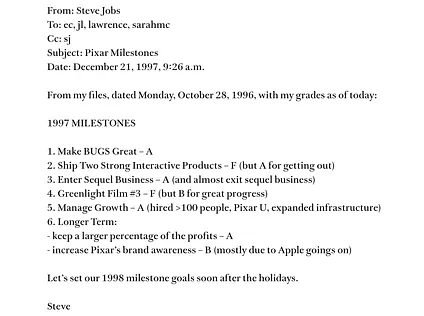
Imagine your boss sending your OKR’s with similar word. “Erald, F for building ops dashboard but A for talking to engineer”
And in case you wondering that this might be a one time thing, here’s the email for 1998’s milestone. This is screenshot straight from “Make Something Wonderful” (you can check the website in here also)
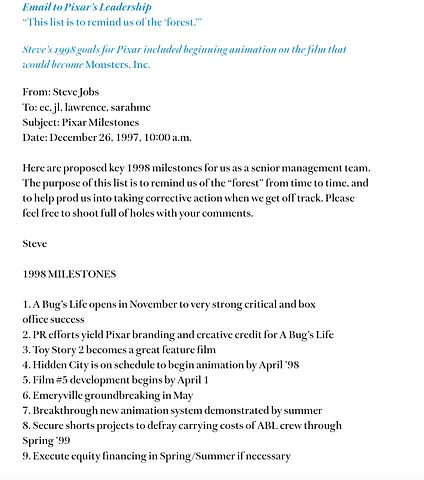
Catch it, yet?
Alright, in case you missed it:
- Firstly, goodness, I absolutely adore how we can stumble upon something like this on the internet. Truly, this is the best time for learners. And,
- Secondly, you might have noticed there’s no OKR or sub-objective in the email above. None. In the 1997 email, Steve simply used “A,” “C,” and “F” like a fifth-grade report and included a brief note on what the team could improve. That’s all.
Now, to be fair to Steve, some of the milestones he set in 1998 are quite specific. Take, for example, milestone number five: “Film #5 development begins by April 1.” Yet, I bet Pixar execs will still scratching their heads when reading the remaining milestones. How do they’ll even communicating this to the rest of the team?
However, in hindsight, we know that Pixar has evolved into an enormously successful and creative powerhouse.
Does this mean we should prefer Steve’s approach to setting milestones? Not exactly. Because at the opposite end of the spectrum, we also have someone like Andy Grove with his operational talent and obsession for metric-driven processes. Andy is also the person who inspired John Doerr about OKRs, which he later introduced to Google and other companies he invested in. And this is before OKRs become a go-to system that nearly all companies use nowadays.
And, much like Pixar, Intel has achieved tremendous success too.
To be entirely honest, being an analytical person myself, I’d prefer more bosses to embrace Andy Grove’s approach over Steve’s. Having “Hit MRR 1 million USD - Failed” is definitely more informative than seeing “Revenue Generation - F” on your 1on1 document.
However, Steve’s case above also bolsters the argument that what’s necessary for company to have good decision system isn’t just specific goals and sub-goals, but also a sense of process. Essentially, it resonates with the same spirit as Ribbonfarm’s article mentioned earlier. Overpowered metrics will eat underspecified goals.
I’ll delve deeper into this topic in future newsletters
Tactical Periodisation and talking about “Decision Space”
I’m an avid football fan. And if you’re like me, you probably often wonder how all these players know what to do on the pitch—whom to pass to, when to accelerate the tempo, or when to remain composed and wait for support. (If you think all of this is easy, try playing in a competitive manner. You’ll quickly appreciate the big gap between professional players and us mere mortals).
As it turns out, this is a significant challenge for football coaches as well. Coaches can’t simply shout out every tactic and action they want their player to do during a match, so they rely on the players to instinctively execute the main strategies correctly and remind them if something out of order or need some change.
With that background, let’s us dive into one of football training methodology (fancy way for saying method for solving problem’s above) called “Tactical Periodisation”. Famous coach like Jose Mourinho and Brendan Rodgers are proponent of this coaching style.
I don’t want to fully explain it in this post (there’s a good video from Tifo Football that give brief summary about it), but I want mention about part that I found interesting.
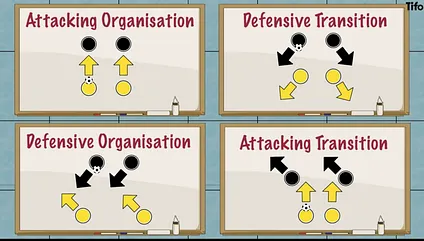
It’s about what they called “4 phases of the game”. It captures the 4 condition that player in the field would face in every match that they’ll play.
These stages is pretty straightforward: assuming both team want to win the match, they’ll experience all of this stage: “Attacking Organisation”, “Defensive Organisation”, “Attacking Transition” and “Defensive Transition”.
This is a key part of tactical periodisation. Everything is geared towards training players to know what to do in each situation that arises within these four phases
- Tifo Football
Pretty obvious, huh? But what lessons can we learn from this?
Much like the “4 phases of the game” in tactical periodization, I believe there’s a similar concept within a business domain. I often refer to it as the ‘Decision Space’: a set of actions that a business team can take, contingent upon the specific situation they find themselves in. (If you’re familiar with a more technical term to describe this, please feel free to comment below).
Still, in a ill-structured domain like business, we can’t expect the stage to be clearly divided into 4 stage like what we have in football above. While you might realize that your current business phase resembles a ‘winter-brace-for-impact’ scenario, are you really ready to slash product development or instead will invest more heavily in it?
There are still numerous nuances, but mapping them all I believe is not impossible.
Having a general understanding of the potential actions a business team can take aids us as analysts in narrowing down our recommendations. Bonus point if we can discover and add more space for stakeholder that previously unknown to them.
Well, story for another time.
1 Big Question
What are the most important statistical ideas of the past 50 years?
Actually, there’s post that talking about this. Here’s from Marginal Revolution’s.
1 Quote
“All the other banks were failing. What better time to start a bank? If everybody else is going broke, that simply means your competition is going away”.
Andy Beal on starting a bank during the Texas oil and real estate bust (tweet from Frederik Gieschen here. I’m a fan of his Substack, Neckar’s Alchemy of Money)
1 Meme Found in the Wild
This is a new section that I use to share hilarious meme that I found in the wild. Might not be consistent section in my newsletter though (will put this once in a while). But I guess there’s no downside in funny meme:D

Naruto never see that coming.
Thank you folks and see you around!